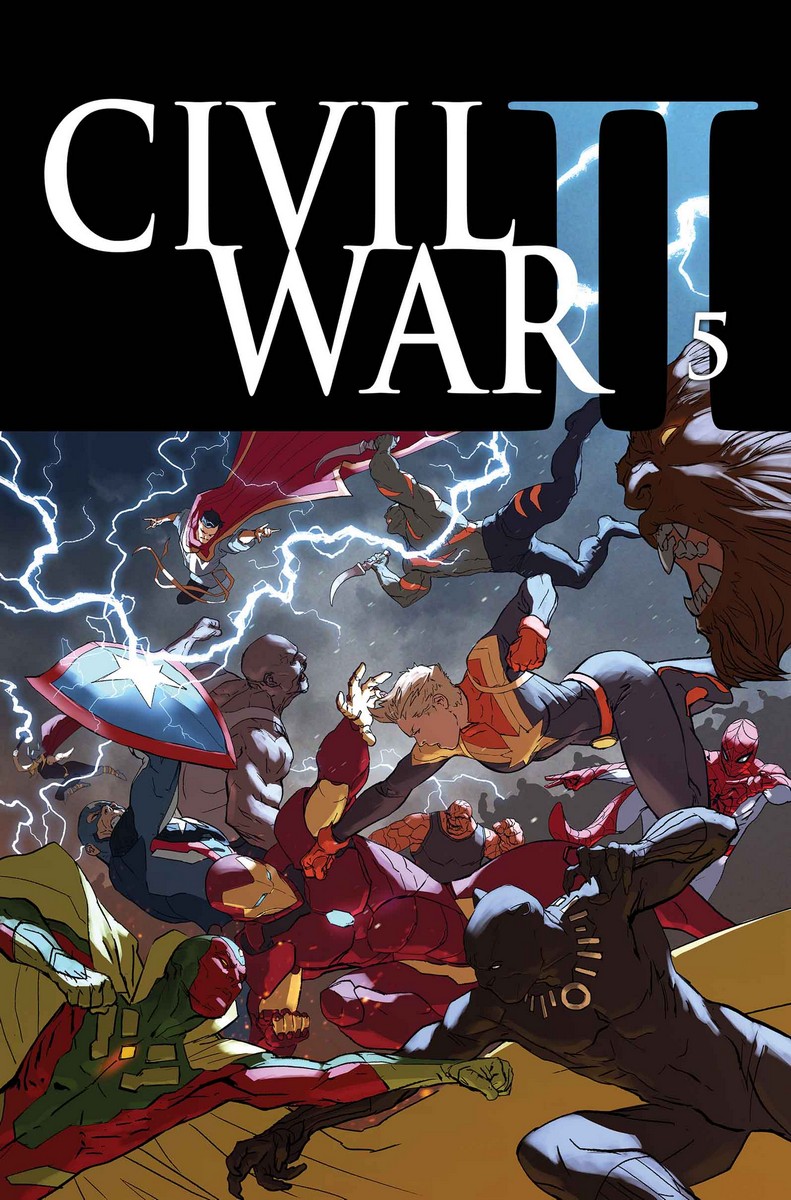
So the sprawling saga of Civil War II lumbers to an end, and as always with Big Event books, the question is: 1) does it have a strong ending; and 2) does it make significant changes?
I've been dubious about the whole story, based around an Inhuman named Ulysses who gets glimpses of the future - but is he seeing what will be, what might be, or is he affecting the future somehow?
It set up a moral dilemma that resulted in death (of course, because that's what happens in Event books), and set Iron Man (and his allies) against Captain Marvel (and her allies).
All of which led to a huge battle between the two on the steps of the Capitol in Washington, D.C. - which is silly, of course. (What hero allows a huge, energy-splashing battle there?)
But I have to admit, the wrap-up to the story of Ulysses is actually a surprise, ties up that part of the story up well and offers potential for future stories.
As for how significant the changes are, it seems minimal so far - but the most significant seems to be its effect on Tony Stark.
The conclusion lifts this series up a bit - and it's certainly better than the "first" (Marvel) Civil War - but it's still a thin excuse for a bunch of heroes too whale on each other.
Grade: B
------------------
Showing posts with label Civil War. Show all posts
Sunday, January 1, 2017
Wednesday, November 23, 2016
Civil War II #7 (of 8)
It's safe to say that the Civil War II mini-series is better than the first Civil War mini-series - but that's faint praise.
The fact is, they're both a mess.
The original series was dopey because it was just a thin excuse for a conflict between heroes - the conflict could have been settled by Iron Man and Captain America over dinner, avoiding needless deaths and loads of destruction.
Now "II" is apparently veering into the same nonsensical territory, as the story starts breaking down.
This issue checks in with the Inhuman named Ulysses as he has a vision of the distant future, of a dystopian world and its (possible) cause.
We see Spider-Man (Miles Morales), who appeared in a vision of the future as the murderer of a certain high-profile hero, as he arrives at the scene of that crime. Why? Who knows?
The issue wraps up with yet another brutal fight between heroes. Why are they fighting? Who knows?
I keep hoping this story will take a surprising turn and reveal the clever twist I haven't spotted yet.
Instead, it keeps grinding out the same ol' stuff - silly fights, meaningless crossover, useless deaths and plot points that will be forgotten in six months. (Heck, they still haven't wrapped up key points from the Original Sin series two years ago - perhaps they hope we've forgotten about it by now.)
There's still time - there's one more issue in this series - but I expected more from writer Brian Michael Bendis. (To be fair, the art by David Marquez is excellent.)
Grade: B-
--------------------------
The fact is, they're both a mess.
The original series was dopey because it was just a thin excuse for a conflict between heroes - the conflict could have been settled by Iron Man and Captain America over dinner, avoiding needless deaths and loads of destruction.
Now "II" is apparently veering into the same nonsensical territory, as the story starts breaking down.
This issue checks in with the Inhuman named Ulysses as he has a vision of the distant future, of a dystopian world and its (possible) cause.
We see Spider-Man (Miles Morales), who appeared in a vision of the future as the murderer of a certain high-profile hero, as he arrives at the scene of that crime. Why? Who knows?
The issue wraps up with yet another brutal fight between heroes. Why are they fighting? Who knows?
I keep hoping this story will take a surprising turn and reveal the clever twist I haven't spotted yet.
Instead, it keeps grinding out the same ol' stuff - silly fights, meaningless crossover, useless deaths and plot points that will be forgotten in six months. (Heck, they still haven't wrapped up key points from the Original Sin series two years ago - perhaps they hope we've forgotten about it by now.)
There's still time - there's one more issue in this series - but I expected more from writer Brian Michael Bendis. (To be fair, the art by David Marquez is excellent.)
Grade: B-
--------------------------
Labels:
Civil War
Wednesday, October 26, 2016
Civil War II #6 (of 8)
I think I've finally figured out why the Civli War II mini-series just isn't generating any heat.
It's certainly trying. It's included the "death" (wink-wink) of one of Marvel's biggest Silver Age characters, plus some others. It has lots of fighting between heroes as they decide which side of this silly division they fall on.
It also includes numerous guest stars and lots of action.
So why does it seem to be getting a lukewarm reaction from the fans?
I think it's because the series feels like it's padded out with dream sequences (which I, for one, hate).
They're not exactly dream sequences - they're actually visions of the future by the Inhuman named Ulysses. It allows for some shocking images (such as the death of another icon that kicks off this issue), but it's a cheat, since that image is - so far - just imaginary.
The issue focuses on a moral dilemma - namely, how do you punish someone for something they haven't done yet?
It's an interesting thought, but as an 8-issue mini-series, it feels mighty thin and ultimately inconsequential.
Grade: B
-----------------
It's certainly trying. It's included the "death" (wink-wink) of one of Marvel's biggest Silver Age characters, plus some others. It has lots of fighting between heroes as they decide which side of this silly division they fall on.
It also includes numerous guest stars and lots of action.
So why does it seem to be getting a lukewarm reaction from the fans?
I think it's because the series feels like it's padded out with dream sequences (which I, for one, hate).
They're not exactly dream sequences - they're actually visions of the future by the Inhuman named Ulysses. It allows for some shocking images (such as the death of another icon that kicks off this issue), but it's a cheat, since that image is - so far - just imaginary.
The issue focuses on a moral dilemma - namely, how do you punish someone for something they haven't done yet?
It's an interesting thought, but as an 8-issue mini-series, it feels mighty thin and ultimately inconsequential.
Grade: B
-----------------
Labels:
Civil War
Wednesday, September 21, 2016
Civil War II #5 (of 8)
So finally we get down to the no-holds-barred, "big ol' pile of superheroes fighting another big ol' pile of superheroes" part of our program.
Which is pretty much what you'd expect from Civil War II.
And this issue delivers in spades as the heroes who support Iron Man get into a fight with the ones who support Captain Marvel.
But there are things about the groupings that make no sense. Don't the mutants (like the X-Men) hate the Inhumans for what the Terrigen Mist has done? So why are some of them fighting on the same side?
And the Guardians of the Galaxy have been friends / allies with both IM and CM - so why would they choose a side and jump into the fight?
Actually, that's the thing about this series that I can't shake - the sense that writer Brian Michael Bendis is using this as a platform to promote the various series that he writes (Iron Man, Guardians, Spider-Man) instead of crafting an expansive story using everyone in the Marvel universe.
But the art by David Marquez is terrific and there's plenty of "Holy cow" moments - even if they don't always make much sense, and we still don't understand what is happening with the Inhuman Ulysses and his powers.
But if you're looking for lots of action, this issue checks that box!
Grade: A-
----------------------
Which is pretty much what you'd expect from Civil War II.
And this issue delivers in spades as the heroes who support Iron Man get into a fight with the ones who support Captain Marvel.
But there are things about the groupings that make no sense. Don't the mutants (like the X-Men) hate the Inhumans for what the Terrigen Mist has done? So why are some of them fighting on the same side?
And the Guardians of the Galaxy have been friends / allies with both IM and CM - so why would they choose a side and jump into the fight?
Actually, that's the thing about this series that I can't shake - the sense that writer Brian Michael Bendis is using this as a platform to promote the various series that he writes (Iron Man, Guardians, Spider-Man) instead of crafting an expansive story using everyone in the Marvel universe.
But the art by David Marquez is terrific and there's plenty of "Holy cow" moments - even if they don't always make much sense, and we still don't understand what is happening with the Inhuman Ulysses and his powers.
But if you're looking for lots of action, this issue checks that box!
Grade: A-
----------------------
Labels:
Civil War
Wednesday, July 27, 2016
Civil War II #4 (of 7)
I'm really struggling to keep an open mind about Civil War II, because I'm trying to keep my opinion from being colored by my negative reaction to the original mini-series.
I've been hoping that this time around, the story would lean more toward the excellent film version - but I'm still on the fence here.
That's because the story is a bit of a sludge, following the idea of an Inhuman named Ulysses who sees visions of the future - making it possible for heroes to act in time to stop major problems before they happen.
It's an idea that Iron Man has been opposed to - and in this issue he explains why.
It also focuses in on the problems the predictions cause - and on Captain Marvel's unwavering devotion to the predictions.
The lesson of the film is that we have to be able to see both sides of the argument to secure the emotional punch of seeing two people who (deep down) like and respect each other being placed on opposite sides.
The original mini-series simply gave us a hero (Captain America) and a villain (Iron Man). This series seems to be shaping up the same way, with Tony Stark being the hero this time, and Carol Danvers the villain.
I hope I'm wrong and it comes together into a more coherent conflict (and eventual resolution). Right now it's looking a bit shaky.
Grade: B
------------------
I've been hoping that this time around, the story would lean more toward the excellent film version - but I'm still on the fence here.
That's because the story is a bit of a sludge, following the idea of an Inhuman named Ulysses who sees visions of the future - making it possible for heroes to act in time to stop major problems before they happen.
It's an idea that Iron Man has been opposed to - and in this issue he explains why.
It also focuses in on the problems the predictions cause - and on Captain Marvel's unwavering devotion to the predictions.
The lesson of the film is that we have to be able to see both sides of the argument to secure the emotional punch of seeing two people who (deep down) like and respect each other being placed on opposite sides.
The original mini-series simply gave us a hero (Captain America) and a villain (Iron Man). This series seems to be shaping up the same way, with Tony Stark being the hero this time, and Carol Danvers the villain.
I hope I'm wrong and it comes together into a more coherent conflict (and eventual resolution). Right now it's looking a bit shaky.
Grade: B
------------------
Labels:
Civil War
Wednesday, July 13, 2016
Civil War II #3
It has become a requirement for Big Event Books (like Civil War II) to include one element: the death of a major character.
And for the really big events, you need more deaths, more often.
Which brings us to this issue, and yep - a shocking, surprising, game-changing, no fooling death of a major character.
Of course, by now fans are inured to such things - we know that eventually the one(s) who died will return (say it with me: if Bucky can return to life, anyone can).
None of which is to say that this isn't a good issue. The art is terrific and the story is genuinely compelling, as it unfolds an incredibly tense, life-or-death situation from several different viewpoints before, during and after the "event."
It all centers around the Inhuman Ulysses and his ability to predict the future. His latest vision is of the Hulk killing - well, everyone - so a gathering of heroes goes to confront the problem head-on.
What could go wrong, right?
I have to admit that I'm still not sure about this series - though I readily admit that may be because I didn't like the original Civil War mini-series. At all. (I loved the movie!)
But this series has taken some interesting turns, and the final page teases some new twists that may provide new surprises. We'll see.
Oh, and that character who was killed? By the end of the issue at least: still dead.
Grade: A-
--------------------
And for the really big events, you need more deaths, more often.
Which brings us to this issue, and yep - a shocking, surprising, game-changing, no fooling death of a major character.
Of course, by now fans are inured to such things - we know that eventually the one(s) who died will return (say it with me: if Bucky can return to life, anyone can).
None of which is to say that this isn't a good issue. The art is terrific and the story is genuinely compelling, as it unfolds an incredibly tense, life-or-death situation from several different viewpoints before, during and after the "event."
It all centers around the Inhuman Ulysses and his ability to predict the future. His latest vision is of the Hulk killing - well, everyone - so a gathering of heroes goes to confront the problem head-on.
What could go wrong, right?
I have to admit that I'm still not sure about this series - though I readily admit that may be because I didn't like the original Civil War mini-series. At all. (I loved the movie!)
But this series has taken some interesting turns, and the final page teases some new twists that may provide new surprises. We'll see.
Oh, and that character who was killed? By the end of the issue at least: still dead.
Grade: A-
--------------------
Labels:
Civil War
Thursday, June 16, 2016
Civil War II #2
There was always a big problem facing this new take on Civil War - it had to compete with the feature film.
So far, the comics event has been on the losing end of that equation.
Its only hope to win was to create a really compelling story - a rock-solid justification for two groups of heroes to fight.
Instead, the series has, so far, followed the model of the original mini-series and made Tony Stark into a villain.
Incensed over the death of an ally, Iron Man goes in search of an Inhuman with a power that promises to change the world - but in doing so, he threatens to ignite a war between that powerful race and humanity.
Aside from his usual sharp dialogue, Stark acts totally out of character here - and there's no real reason for his actions (or the shocking event at the end of the issue).
There's still time for this series to take off - but so far, it's been slow going.
Grade: B-
------------------
So far, the comics event has been on the losing end of that equation.
Its only hope to win was to create a really compelling story - a rock-solid justification for two groups of heroes to fight.
Instead, the series has, so far, followed the model of the original mini-series and made Tony Stark into a villain.
Incensed over the death of an ally, Iron Man goes in search of an Inhuman with a power that promises to change the world - but in doing so, he threatens to ignite a war between that powerful race and humanity.
Aside from his usual sharp dialogue, Stark acts totally out of character here - and there's no real reason for his actions (or the shocking event at the end of the issue).
There's still time for this series to take off - but so far, it's been slow going.
Grade: B-
------------------
Labels:
Civil War
Thursday, June 2, 2016
Civil War II #1
I almost passed on Marvel's new Civil War II event.
After all, I didn't like the original mini-series.
On the other hand, I loved the recent film.
(I didn't read the Secret Wars spin-off.)
At the last minute, I decided to give this series a shot. After all, it's written by Brian Michael Bendis, who's a reliable comics veteran. It's drawn by David Marquez, who provides solid work.
This is the kind of event that promises big things as it spills out across virtually the entire Marvel line - the story affects almost every title.
Of course, it doesn't take much to get Marvel's heroes to fight - it's a time-honored tradition - but the impetus here is pretty slim (at least at the beginning), as a new Inhuman gains the power to see the future. But how should that power be used?
The issue begins with a bang, as a cosmic menace threatens the Earth.
But then it all jumps the rails, as a couple of big important strum and drang (life-threatening) events take place - but they're almost entirely "off-camera." In other words, the stunning event doesn't take place in this issue - it happens over in The Ultimates.
What we see is the aftereffect, which promises to amp up the emotions of the heroes and bring the conflict into the spotlight.
It just feels thin and forced - and I find I really don't much care about the setup.
It's going to have to get better fast to persuade me to change my mind, but right now, I think I should have trusted my first instinct and passed on this event.
Grade: C+
-------------------------
After all, I didn't like the original mini-series.
On the other hand, I loved the recent film.
(I didn't read the Secret Wars spin-off.)
At the last minute, I decided to give this series a shot. After all, it's written by Brian Michael Bendis, who's a reliable comics veteran. It's drawn by David Marquez, who provides solid work.
This is the kind of event that promises big things as it spills out across virtually the entire Marvel line - the story affects almost every title.
Of course, it doesn't take much to get Marvel's heroes to fight - it's a time-honored tradition - but the impetus here is pretty slim (at least at the beginning), as a new Inhuman gains the power to see the future. But how should that power be used?
The issue begins with a bang, as a cosmic menace threatens the Earth.
But then it all jumps the rails, as a couple of big important strum and drang (life-threatening) events take place - but they're almost entirely "off-camera." In other words, the stunning event doesn't take place in this issue - it happens over in The Ultimates.
What we see is the aftereffect, which promises to amp up the emotions of the heroes and bring the conflict into the spotlight.
It just feels thin and forced - and I find I really don't much care about the setup.
It's going to have to get better fast to persuade me to change my mind, but right now, I think I should have trusted my first instinct and passed on this event.
Grade: C+
-------------------------
Labels:
Civil War
Friday, May 20, 2016
Civil War II #0
Since the movie is (deservedly) a huge hit, it's no surprise that Marvel has gone back to the well with Civil War II.
There's one thing missing this time around - Captain America.
This time around, it looks like the conflict is going to be between Iron Man and a different Captain - this one is named Marvel.
This issue #0 (I hate issues numbered zero on general principle, I should admit) doesn't give us much to chew on.
There's some nice artwork by the always-excellent Olivier Coipel, but the script by Brian Michael Bendis is disturbing - and not in the ways he intended.
We're just given a handful of scenes without much in the way of context. For example: She-Hulk argues in a case defending a retired super-villain threatened with prison for having a discussion of his past crimes; War Machine (James Rhodes) meets with the President (carefully covered so you can't identify him) who promises to make Rhodey the next president (can he do that?); Captain Marvel meets with Doc Sampson (I thought he was dead?), who does some not-so-subtle analyzing of her state of mind; and the Terrigen Mist sweeps across a campus in Ohio, leaving behind a few cocoons, and three new Inhumans.
How does all that tie together? I have no idea - and the closing pages depict a scene that makes no sense at all. Is it a scene of destruction, an illusion, a vision of the future, or something else? No clue.
Heroes fighting each other is a Marvel staple, and the movie Captain America: Civil War shows how to do it right. The original mini-series, Civil War, shows how to do it badly.
We'll see which category this series ultimately falls into.
Grade: B-
---------------------
There's one thing missing this time around - Captain America.
This time around, it looks like the conflict is going to be between Iron Man and a different Captain - this one is named Marvel.
This issue #0 (I hate issues numbered zero on general principle, I should admit) doesn't give us much to chew on.
There's some nice artwork by the always-excellent Olivier Coipel, but the script by Brian Michael Bendis is disturbing - and not in the ways he intended.
We're just given a handful of scenes without much in the way of context. For example: She-Hulk argues in a case defending a retired super-villain threatened with prison for having a discussion of his past crimes; War Machine (James Rhodes) meets with the President (carefully covered so you can't identify him) who promises to make Rhodey the next president (can he do that?); Captain Marvel meets with Doc Sampson (I thought he was dead?), who does some not-so-subtle analyzing of her state of mind; and the Terrigen Mist sweeps across a campus in Ohio, leaving behind a few cocoons, and three new Inhumans.
How does all that tie together? I have no idea - and the closing pages depict a scene that makes no sense at all. Is it a scene of destruction, an illusion, a vision of the future, or something else? No clue.
Heroes fighting each other is a Marvel staple, and the movie Captain America: Civil War shows how to do it right. The original mini-series, Civil War, shows how to do it badly.
We'll see which category this series ultimately falls into.
Grade: B-
---------------------
Labels:
Civil War
Wednesday, May 11, 2016
The Classics - Civil War #1 - 7
When I was writing my review of the (quite excellent) Civil War movie, I looked into the archives, certain that I'd reviewed the original 2006 mini-series.
But I started this humble blog in 2008, so I never touched on this event.
Which was probably just as well, because I believe the story sets some kind of record for starting out as a great idea - and then plummeting to the depths of dopiness.
Written by Mark Millar, it starts with a terrible incident, as the New Warriors tackle some major villains - and a terrible explosion kills hundreds of children.
The public demands action, so the government decides to require every superhero and supervillain to register and be, essentially, civil service employees working for the government.
The idea splits the ranks right down the middle, with Captain America (surprisingly) opposing the government's plan, and Iron Man championing it. That sets up a terrific action sequence in the first issue, as Cap fights for his life against a army of SHIELD agents determined to bring him in - and artist Steve McNiven, who does great work in this series, shines here.
But from there, the series starts falling apart. Tony Stark (teaming with Reed Richards) employs more and more draconian measures - arresting heroes, throwing them in a prison in the Negative Zone, building a clone of one of his oldest friends, which promptly runs wild - and soon, heroes are being killed.
In other words, everyone on Iron Man's side must become a villain to keep the story going - and they even throw in Spider-Man unmasking publicly, easily the second-worst thing Marvel has ever done to Spidey (Mephisto being the worst).
The ending is the worst offense - because there isn't one. There's no real resolution to the issue, the series just... ends.
It's a real shame, because the series features great art and it started out with such promise. The movie shows what might have been - but this series just ended up being a huge disappointment, an opportunity wasted.
Grade: C-
---------------------
But I started this humble blog in 2008, so I never touched on this event.
Which was probably just as well, because I believe the story sets some kind of record for starting out as a great idea - and then plummeting to the depths of dopiness.
Written by Mark Millar, it starts with a terrible incident, as the New Warriors tackle some major villains - and a terrible explosion kills hundreds of children.
The public demands action, so the government decides to require every superhero and supervillain to register and be, essentially, civil service employees working for the government.
The idea splits the ranks right down the middle, with Captain America (surprisingly) opposing the government's plan, and Iron Man championing it. That sets up a terrific action sequence in the first issue, as Cap fights for his life against a army of SHIELD agents determined to bring him in - and artist Steve McNiven, who does great work in this series, shines here.
But from there, the series starts falling apart. Tony Stark (teaming with Reed Richards) employs more and more draconian measures - arresting heroes, throwing them in a prison in the Negative Zone, building a clone of one of his oldest friends, which promptly runs wild - and soon, heroes are being killed.
In other words, everyone on Iron Man's side must become a villain to keep the story going - and they even throw in Spider-Man unmasking publicly, easily the second-worst thing Marvel has ever done to Spidey (Mephisto being the worst).
The ending is the worst offense - because there isn't one. There's no real resolution to the issue, the series just... ends.
It's a real shame, because the series features great art and it started out with such promise. The movie shows what might have been - but this series just ended up being a huge disappointment, an opportunity wasted.
Grade: C-
---------------------
Labels:
Civil War,
Classic Comics
Subscribe to:
Posts (Atom)